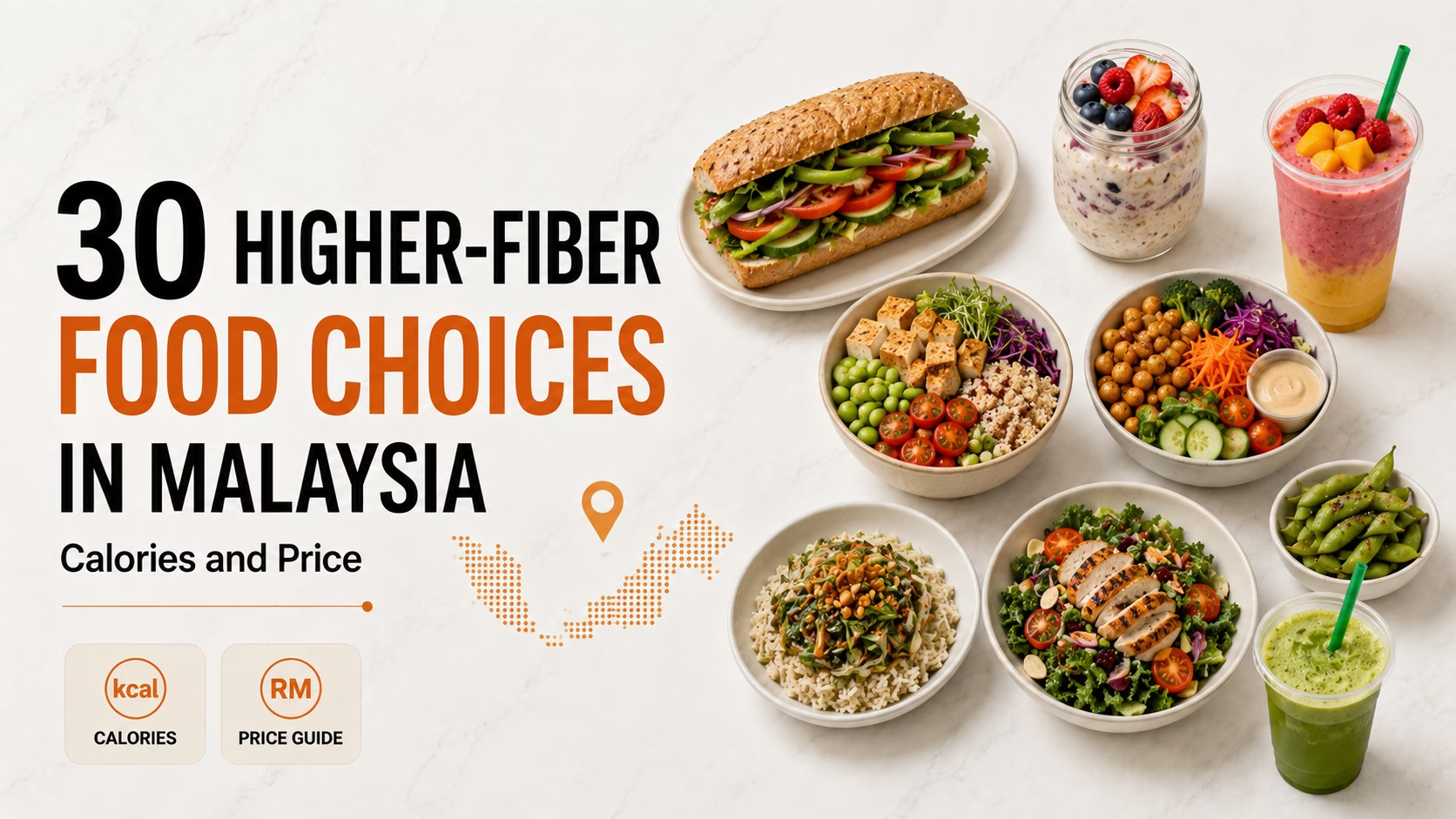
Getting more fiber can be straightforward when you prepare your own meals.
You can cook beans, add lentils, choose whole grains, prepare vegetables, eat fruit, and add nuts or seeds.
But what if you do not want to cook?
Maybe you are:
- Eating lunch outside
- Ordering delivery
- Working late
- Shopping at a mall
- Looking for a quick breakfast
- Buying something on the way to work
- Or simply too tired to prepare food
In those situations, the practical question becomes:
What can you buy in Malaysia that provides a meaningful amount of fiber?
To answer that, we selected 30 restaurant meals, bowls, salads, sandwiches, drinks, porridges, breakfast foods and ready-to-eat options from 10 brands available in Malaysia.
The main focus is dietary fiber.
We also compare:
- Calories
- Approximate price
- Fiber per 100 calories
- Approximate cost for 5 g of fiber
- Whether the fiber value is published or estimated
The goal is not to identify one universally “healthiest” meal.
It is to help you find practical ways to get more fiber when cooking is not part of the plan.
Important: Menu items, ingredients, recipes, serving sizes, nutrition information and prices can change over time. Published nutrition data are used whenever reliable Malaysia-specific information is available. Where a brand does not publish dietary fiber, approximate fiber values are estimated from the listed ingredients and representative food-composition data. Estimated values should be treated as practical references rather than exact nutrition-label values.
Quick Answer
Some of the most interesting choices in this comparison are:
| Priority | Choice | Approx. Fiber |
|---|---|---|
| Most fiber in a selected sandwich | Subway Footlong Veggie Delite | ~10 g |
| High-fiber breakfast option | La Juiceria Berry Glow Overnight Oats | ~10 g* |
| Customizable fiber-focused bowl | The Fish Bowl quinoa + tofu + edamame build | ~10 g* |
| Plant-based complete meal | La Juiceria Buddha Bowl | ~9 g* |
| Vegetarian local-style meal | BMS Hakka Lei Cha Rice | ~8 g* |
| Higher-fiber salad | Salad Atelier Kale Chicken Salad | ~8 g* |
| Ready meal with vegetables + quinoa | YoloFoods Zesty Moroccan Chicken | ~8 g* |
| Most fiber-efficient drink | Boost Raspberry Mango Crush | 6 g |
| Another strong drink option | Boost 5 A Day Juice | 6 g |
| Low-cost grab-and-go fiber | Signature Market Roasted Edamame | ~5 g* |
*Estimated fiber unless otherwise stated.
Why Fiber Is Harder to Compare Than Protein
For our Malaysia protein guide, many brands published calories and protein directly.
Fiber is different.
Many restaurant nutrition pages publish:
- Calories
- Protein
- Carbohydrates
- Fat
- Sugar
- Sodium
but omit dietary fiber entirely.
Boost Juice Malaysia is an exception: its current nutrition pages explicitly publish dietary fiber alongside calories, protein, sugar, fat and sodium. For example, the Original 500 mL 5 A Day Juice lists 6 g of dietary fiber, Raspberry Mango Crush lists 6 g, Gym Junkie lists 5 g, Protein Supreme lists 5 g, and Energiser Juice lists 4.5 g.
For brands that do not publish fiber, this article uses an estimate based on known ingredients such as:
- Oats
- Chia seeds
- Beans
- Chickpeas
- Edamame
- Quinoa
- Brown rice
- Vegetables
- Fruit
- Nuts
- Seeds
That means the fiber numbers in this article do not all have the same evidence level.
How to Read the Data Basis
We use three labels:
P — Published
The brand directly publishes the fiber value.
R — Reported
A Malaysia-specific secondary nutrition reference publishes the value.
E — Estimated
Eat Ate Here estimated the fiber from the menu’s listed ingredients and representative food-composition data.
An estimated value is useful for comparison, but it should not be treated as an official nutrition claim from the restaurant.
How We Compared These Foods
Fiber per Serving
This is our primary measurement.
It asks:
How many grams of fiber are provided by the item you actually order or eat?
Calories
Calories help put fiber into context.
For example:
6 g fiber for 135 calories
and
6 g fiber for 600 calories
provide the same fiber quantity but are very different foods.
Fiber per 100 Calories
We calculate:
Fiber ÷ Calories × 100
This tells you how much fiber the food provides relative to energy.
It does not tell you whether the food is better overall.
Cost for 5 g of Fiber
For this eating-out series, 5 g is a more practical standardized comparison than 10 g because many single restaurant servings provide roughly 4–10 g.
We calculate:
Price ÷ Fiber × 5
This asks:
How much would approximately 5 g of fiber cost from this option?
Again, this measures fiber value—not the total value of the meal.
What Does 5 g of Fiber Mean?
The FDA Daily Value for dietary fiber is:
28 g per day
based on a 2,000-calorie diet.
So approximately:
| Fiber | Approx. %DV |
|---|---|
| 4 g | ~14% |
| 5 g | ~18% |
| 6 g | ~21% |
| 8 g | ~29% |
| 10 g | ~36% |
The FDA’s general label guide considers:
- 5% DV or less low
- 20% DV or more high
That means approximately 5.6 g or more per serving reaches 20% of the 28 g DV.
30 Higher-Fiber Food Choices in Malaysia
The foods are approximately ordered by fiber per listed serving.
| Rank | Brand & Food | Fiber | Calories | Approx. Price | Data |
|---|---|---|---|---|---|
| 1 | Subway Footlong Veggie Delite | ~10 g | ~460 | ~RM21.70 | R |
| 2 | La Juiceria Berry Glow Overnight Oats | ~10 g | 575 | ~RM18.90 | E |
| 3 | The Fish Bowl BYO Quinoa + Tofu + Edamame + Vegetables | ~10 g | ~500 | ~RM25 | E |
| 4 | La Juiceria Buddha Bowl | ~9 g | 620 | ~RM22.90 | E |
| 5 | BMS Organics Vegetarian Fiber Crazy Poke Bowl | ~9 g | ~450 | RM23.90 | E |
| 6 | Salad Atelier Chicken Teriyaki Poke | ~8 g | ~500 | ~RM25 | E |
| 7 | Salad Atelier Kale Chicken Salad | ~8 g | 485 | RM29.90 | E |
| 8 | YoloFoods Zesty Moroccan Chicken Breast with Root Vegetables, Quinoa & Broccoli | ~8 g | 425 | ~RM17.50 | E |
| 9 | Simple Life Lei Cha | ~8 g | ~450 | RM22.00 | E |
| 10 | BMS Organics Hakka Lei Cha Rice | ~8 g | ~450 | RM22.90 | E |
| 11 | La Juiceria Teriyaki Tofu Poke Bowl | ~8 g | 551 | RM21.90 | E |
| 12 | Salad Atelier Sawadee Thai Salad | ~7 g | 372 | RM29.90 | E |
| 13 | The Fish Bowl Vegan Tofu Bowl | ~7 g | ~450 | ~RM19–22 | E |
| 14 | The Fish Bowl Hawaiian Tofu | ~7 g | ~450 | ~RM14.90 | E |
| 15 | BMS Organics Multigrain Rice With Satay Sauce | ~6 g | ~500 | RM19.90 | E |
| 16 | Simple Life Peanut Millet Porridge | ~6 g | ~330 | RM19.50 | E |
| 17 | La Juiceria Fried Rice Quinoa | ~6 g | 411 | RM22.90 | E |
| 18 | YoloFoods Chicken Madras Curry with Basmati Rice, Corn & Peas | ~6 g | 434 | ~RM17.50 | E |
| 19 | YoloFoods Teriyaki Salmon with Brown Rice, Kimchi & Edamame | ~6 g | 444 | ~RM17.50 | E |
| 20 | Boost 5 A Day Juice — Original | 6 g | 155 | RM16.40 | P |
| 21 | Boost Raspberry Mango Crush — Original | 6 g | 135 | ~RM14–16 | P |
| 22 | Salad Atelier Creamy Broccoli Chicken Bowl | ~6 g | 590 | RM28.75 | E |
| 23 | Simple Life Wild Yam Millet Porridge | ~5 g | ~300 | RM20.50 | E |
| 24 | Boost Gym Junkie — Original | 5 g | 350 | ~RM18 | P |
| 25 | Boost Protein Supreme — Original | 5 g | 450 | ~RM20 | P |
| 26 | Subway 6-Inch Veggie Delite | ~5 g | ~230 | RM12.90 | R |
| 27 | Amazin’ Graze Low Sugar Wild Strawberry Granola — ~40 g | ~5 g | ~170 | ~RM3.50 | E |
| 28 | Signature Market Roasted Edamame — ~30 g | ~5 g | ~130 | ~RM1.42 | E |
| 29 | Boost Energiser Juice — Original | 4.5 g | 180 | RM15.40 | P |
| 30 | Subway Veggie Delite Wrap | ~4 g | ~330 | RM14.00 | R/E |
Boost’s fiber figures are directly published on the Malaysia brand site. Current Malaysia delivery listings also show, for example, 5 A Day Juice around RM16.40 and Energiser Juice around RM15.40 in sampled outlets.
Subway Malaysia currently sells Veggie Delite in 6-inch, footlong and wrap formats; sampled 2026 delivery menus show approximately RM12.90 for a 6-inch Veggie Delite, RM21.70 for the footlong and RM14 for the wrap. Malaysia-focused nutrition references place the 6-inch Veggie Delite around 5 g fiber.
Price Note: Prices are approximate 2026 Malaysia reference prices. Actual prices can vary by outlet, state, ordering platform, promotion, portion, dine-in/takeaway channel and time.
Which Choices Actually Reach About 20% of the Fiber Daily Value?
Because 20% of the FDA’s 28 g Daily Value is approximately 5.6 g, items providing around 6 g or more reach roughly 20% DV or above.
That includes many selections near the top of our table.
Examples include:
- Subway Footlong Veggie Delite
- La Juiceria Berry Glow
- La Juiceria Buddha Bowl
- BMS Fiber Crazy Poke Bowl
- BMS Hakka Lei Cha Rice
- Salad Atelier Chicken Teriyaki Poke
- Salad Atelier Kale Chicken Salad
- YoloFoods Zesty Moroccan Chicken
- Simple Life Lei Cha
- La Juiceria Teriyaki Tofu Poke
- Salad Atelier Sawadee Thai Salad
- The Fish Bowl tofu-based bowls
- Boost 5 A Day Juice
- Boost Raspberry Mango Crush
For estimated items, this should be interpreted approximately rather than as an official high-fiber label claim.
Which Choice Has the Most Fiber?
Among the practical selections, several are around the 10 g fiber level.
Subway Footlong Veggie Delite
A footlong portion effectively doubles the bread and vegetable serving compared with the 6-inch version.
A standard footlong Veggie Delite can provide roughly 10 g fiber, although customization can change this.
Current Malaysia ordering menus show Veggie Delite is still sold in both 6-inch and footlong formats.
The obvious trade-off is portion size.
More food naturally produces more fiber.
So a footlong should not automatically be considered a more efficient fiber choice than a smaller meal.
La Juiceria Berry Glow Overnight Oats
Berry Glow contains foods such as:
- Rolled oats
- Chia seeds
- Acai
- Strawberries
- Dragon fruit
- Coconut
These ingredients make it one of the strongest fiber candidates in the La Juiceria menu.
La Juiceria’s current macro information lists Berry Glow at 575 calories, and the menu lists a single overnight oat around RM18.90. The fiber figure here is an Eat Ate Here estimate because La Juiceria’s published macro image lists calories, carbohydrates, protein and fat but not dietary fiber.
This distinction is important:
the ingredients strongly suggest meaningful fiber, but ~10 g is an estimate—not a brand-published number.
Which Choices Give the Most Fiber per 100 Calories?
This changes the ranking substantially.
Among our selected options, some of the strongest are:
| Food | Fiber | Calories | Fiber / 100 kcal |
|---|---|---|---|
| Boost Raspberry Mango Crush | 6 g | 135 | ~4.4 g |
| Boost 5 A Day Juice | 6 g | 155 | ~3.9 g |
| Signature Market Roasted Edamame | ~5 g | ~130 | ~3.8 g |
| Amazin’ Graze Wild Strawberry Granola | ~5 g | ~170 | ~2.9 g |
| BMS Fiber Crazy Poke Bowl | ~9 g | ~450 | ~2.0 g |
| YoloFoods Zesty Moroccan Chicken | ~8 g | 425 | ~1.9 g |
| Salad Atelier Sawadee Thai Salad | ~7 g | 372 | ~1.9 g |
Boost Raspberry Mango Crush is particularly interesting because Boost officially lists:
6 g fiber / 135 calories
for its Original serving.
Similarly, the Original 5 A Day Juice provides:
6 g fiber / 155 calories.
However, there is another trade-off.
The same 5 A Day Juice also contains approximately 28 g sugars according to the brand’s nutrition information.
So:
high fiber efficiency does not mean the drink has no other nutritional considerations.
Drinks Can Provide Fiber—but Whole Foods Are Different
This article includes several Boost drinks because the brand publishes unusually detailed fiber data.
That does not mean drinking juice or smoothies should replace:
- Vegetables
- Whole fruit
- Legumes
- Whole grains
- Nuts
- Seeds
A smoothie or blended beverage can retain more fiber than a highly filtered juice, depending on ingredients and preparation.
But a beverage and a bowl of beans, vegetables or grains are still very different foods.
This is why the overall dietary pattern matters.
Which Choices Provide the Best Fiber Value for Money?
When price is compared with fiber, ready-to-eat grocery snacks can perform especially well.
Signature Market Roasted Edamame
Signature Market currently sells roasted edamame in a 180 g pack for around RM8.50.
If you eat around 30 g:
Approx. price: ~RM1.42
Estimated fiber: ~5 g
That makes it one of the cheapest practical fiber contributors in the entire list.
But again, this is a snack portion—not a complete lunch.
Amazin’ Graze Granola
Amazin’ Graze currently sells its Low Sugar Wild Strawberry Granola in a 250 g pack for around RM21.90. It contains rolled oats, chia seeds, melon seeds, coconut and freeze-dried strawberries.
A roughly 40 g portion costs around:
RM3.50
and can contribute approximately 5 g fiber, depending on the actual serving composition.
This is another good example of the difference between:
cheap fiber
and
a complete meal.
What If You Want a Full Meal?
If you are actually hungry for lunch or dinner, a trail mix or drink may not solve the problem.
Complete meals become more relevant.
BMS Organics Hakka Lei Cha Rice
Current BMS Organics menus list Hakka Lei Cha Rice at around RM22.90.
The meal uses a plant-heavy format and is listed as vegan, with peanuts among the ingredients.
Lei cha commonly combines:
- Multigrain or rice
- Vegetables
- Herbs
- Nuts or seeds
- Legume-related ingredients
so it is a strong candidate for a higher-fiber complete meal.
We estimate roughly:
~8 g fiber
depending on portion and recipe.
BMS Fiber Crazy Poke Bowl
This one is especially relevant because the current BMS menu actually calls it:
Vegetarian Fiber Crazy Poke Bowl
and describes it as a bowl packed with fiber-rich ingredients.
It is currently listed from around RM23.90.
However, BMS does not publish a gram value for fiber on that menu page.
Our estimate of approximately 9 g is therefore not an official BMS nutrition value.
Simple Life: Traditional Plant-Based Meals Can Contribute Fiber Too
Simple Life is useful in this series because it focuses heavily on:
- Multigrain rice
- Brown rice noodles
- Millet
- Vegetables
- Plant-based foods
The company itself says its multigrain rice contains more fiber than conventional refined alternatives.
Current menu examples include:
Lei Cha
Approx. fiber: ~8 g
Price: RM22
Peanut Millet Porridge
Approx. fiber: ~6 g
Price: RM19.50
Wild Yam Millet Porridge
Approx. fiber: ~5 g
Price: RM20.50
Current Foodpanda menus show these dishes and prices, and explicitly describe the Wild Yam Millet Porridge as high in fibre.
The gram amounts above remain estimates because Simple Life does not publish a complete nutrition panel for these servings.
Salad Atelier: Look at the Ingredients, Not Just the Word “Salad”
Not every salad automatically contains a large amount of fiber.
A bowl based mostly on lettuce and chicken can still contain relatively modest fiber.
The higher-fiber Salad Atelier choices are those containing ingredients such as:
- Kale
- Avocado
- Chickpeas
- Edamame
- Purple cabbage
- Broccoli
- Nuts
- Seeds
- Corn
Current menus include a Chicken Teriyaki Poke with edamame, chickpeas, carrots and mixed seeds, a Sawadee Thai Salad with kale, edamame and purple cabbage, and a Kale Chicken Salad with kale, avocado, almonds and corn.
That is why those dishes are more interesting for fiber than simply choosing any bowl with “salad” in the name.
La Juiceria: Oats, Chia, Quinoa and Plant-Based Bowls Stand Out
La Juiceria’s menu offers several foods that naturally contain ingredients associated with dietary fiber.
Berry Glow Overnight Oats
Contains oats, chia seeds and fruit.
Estimated fiber: ~10 g
Calories: 575
Approx. price: RM18.90
Buddha Bowl
Contains tofu, roasted pumpkin, mushrooms, rice, vegetables, tempeh chips and cashews.
Estimated fiber: ~9 g
Calories: 620
Approx. price: RM22.90
Teriyaki Tofu Poke Bowl
A tofu-based poke bowl.
Estimated fiber: ~8 g
Calories: ~551
Approx. price: RM21.90
Fried Rice Quinoa
Contains quinoa and multiple vegetables.
Estimated fiber: ~6 g
Calories: 411
Approx. price: RM22.90
La Juiceria publishes detailed current menu macro information for these types of items, but its displayed macro panels do not include fiber, so the fiber values above are estimates.
The Fish Bowl: Customization Can Be an Advantage for Fiber
The Fish Bowl is particularly interesting because users can choose:
- Rice
- Quinoa
- Greens
- Tofu
- Edamame
- Vegetables
- Nuts
- Seeds
- Other toppings
The brand describes its bowls as customizable, with choices including rice, quinoa, greens, protein and multiple sides.
So instead of simply asking:
Which signature bowl has the most fiber?
you can intentionally build one.
For example:
Quinoa + tofu + edamame + vegetables + chia or seeds
would generally be much more fiber-focused than:
white rice + fish + sauce
Our example build is estimated at around 10 g fiber, but the exact number depends entirely on the scoops and toppings chosen.
That is why customizable restaurants should be treated differently from fixed packaged foods.
YoloFoods: Ready Meals Can Combine Protein and Fiber
YoloFoods is useful for people who want something closer to a home-style meal without cooking.
Current meal plans include options such as:
Zesty Moroccan Chicken Breast
with:
- Roasted root vegetables
- Quinoa
- Broccoli
425 calories
We estimate around:
~8 g fiber
depending on the actual vegetable and quinoa portions.
Chicken Madras Curry
with:
- Basmati rice
- Sweet corn
- Green peas
434 calories
Estimated:
~6 g fiber
Teriyaki Salmon
with:
- Brown rice
- Kimchi
- Edamame
444 calories
Estimated:
~6 g fiber
These are examples where choosing a meal with vegetables, legumes or whole grains changes the fiber profile without making fiber the only nutrient in the meal.
What If You Want About 5 g of Fiber?
Several convenient foods sit around the 5 g level:
- Boost Gym Junkie
- Boost Protein Supreme
- Subway 6-Inch Veggie Delite
- Simple Life Wild Yam Millet Porridge
- Amazin’ Graze Wild Strawberry Granola
- Signature Market Roasted Edamame
Five grams represents approximately:
18% of the FDA 28 g Daily Value.
So one of these options can make a meaningful contribution, even though it is slightly below the FDA’s general 20% threshold for a “high” amount.
What If You Want Fiber Under 200 Calories?
Among the selected options:
Boost Raspberry Mango Crush
6 g fiber / 135 kcal
Boost 5 A Day Juice
6 g / 155 kcal
Signature Market Roasted Edamame
~5 g / ~130 kcal
Amazin’ Graze Wild Strawberry Granola
~5 g / ~170 kcal
Boost Energiser Juice
4.5 g / 180 kcal
These are much smaller foods or drinks than a complete restaurant meal.
So the low calorie total should not automatically be interpreted as superior.
A 135-calorie drink and a 500-calorie lunch are serving different purposes.
What If You Want Fiber and Protein Together?
This is where our Protein series and Fiber series begin to overlap.
Consider foods containing:
- Beans
- Lentils
- Edamame
- Tofu
- Quinoa
- Nuts
- Seeds
These can contribute both nutrients.
Examples from this comparison include:
La Juiceria Teriyaki Tofu Poke Bowl
Plant protein + estimated meaningful fiber.
The Fish Bowl Tofu Builds
Tofu + edamame + quinoa + vegetables can contribute both.
YoloFoods Zesty Moroccan Chicken
Chicken supplies protein while quinoa, root vegetables and broccoli contribute fiber.
Salad Atelier Chicken Teriyaki Poke
Chicken contributes protein, while chickpeas, edamame, vegetables and seeds contribute fiber.
Boost Protein Supreme
Boost publishes:
29 g protein + 5 g fiber
for the Original serving.
This is a good reminder that protein and fiber do not need to be treated as competing priorities.
Is Drinking Fiber the Same as Eating Fiber-Rich Foods?
Not exactly.
The total grams matter, but fiber characteristics and the rest of the food matter too.
As explained in our main Fiber guide, different fibers differ in properties such as:
- Solubility
- Viscosity
- Fermentability
- Water-holding capacity
Whole plant foods also provide their fiber within a physical food structure.
So a smoothie containing 6 g fiber and a meal containing 6 g from beans, whole grains and vegetables do not necessarily behave identically.
The fiber number is useful.
It is not the entire story.
Do You Need a “High-Fiber” Meal Every Time You Eat?
No.
Fiber intake accumulates across the day.
A commonly used reference framework is approximately:
14 g fiber per 1,000 calories
and the FDA label Daily Value is 28 g/day for a 2,000-calorie diet.
You could obtain fiber from:
Breakfast
- lunch
- fruit
- snacks
- dinner
rather than expecting one restaurant meal to provide your entire daily intake.
For example:
6 g at breakfast
- 8 g at lunch
- 5 g from fruit/snacks
- 9 g at dinner
= approximately 28 g
The purpose of this article is therefore not:
Find one giant fiber meal.
It is:
Find easier opportunities to add fiber when you are eating away from home.
Fiber Is Still Only One Part of the Meal
This is especially important when looking at restaurant food.
A meal can provide a lot of fiber while also containing considerable:
- Calories
- Fat
- Sodium
- Sugar
Likewise, a meal with moderate fiber might provide substantial:
- Protein
- Vitamins
- Minerals
- Other useful nutrients
For example, Boost 5 A Day Juice provides 6 g of fiber, but the brand also lists 28 g of sugars in the Original serving.
La Juiceria Berry Glow likely provides meaningful fiber from oats, chia and fruit, but its published calorie value is 575 kcal.
Neither fact automatically makes the food good or bad.
It tells you more about the trade-off.
Which Higher-Fiber Choice Might Suit You?
| Your Priority | Choices to Consider |
|---|---|
| Most fiber in a sandwich | Subway Footlong Veggie Delite |
| Fiber-focused breakfast | La Juiceria Berry Glow |
| Plant-based complete bowl | La Juiceria Buddha Bowl |
| Traditional Malaysian-style choice | BMS / Simple Life Lei Cha |
| Customizable fiber | The Fish Bowl quinoa + tofu + edamame build |
| Salad with legumes/seeds | Salad Atelier Chicken Teriyaki Poke |
| Ready meal | YoloFoods Zesty Moroccan Chicken |
| Fiber in a lower-calorie drink | Boost Raspberry Mango Crush / 5 A Day Juice |
| Fiber + protein drink | Boost Protein Supreme |
| Cheap grab-and-go fiber | Signature Market Roasted Edamame |
| Portable breakfast/snack | Amazin’ Graze granola |
A Better Way to Order for More Fiber
Instead of asking:
“Which menu item has the most fiber?”
ask several questions.
Does It Contain Legumes?
Look for:
- Beans
- Chickpeas
- Lentils
- Edamame
- Peas
These can substantially increase fiber.
Does It Use Whole Grains?
Examples include:
- Oats
- Quinoa
- Brown rice
- Multigrain rice
- Millet
Are There Actually Enough Vegetables?
A few lettuce leaves do not automatically make a meal high in fiber.
Look for bowls containing several substantial vegetable components.
Are Nuts or Seeds Included?
Examples include:
- Chia seeds
- Almonds
- Peanuts
- Cashews
- Mixed seeds
These can contribute fiber, but they can also add significant calories.
What Is the Serving Size?
A footlong sandwich may contain more fiber simply because it contains twice as much food as a 6-inch sandwich.
What Else Comes With the Fiber?
Look at:
- Calories
- Protein
- Sugar
- Fat
- Sodium
where reliable information is available.
What the Numbers Do Not Tell You
Even a detailed table has limitations.
Estimated Fiber Is Not Laboratory Data
Several restaurant brands do not publish fiber.
Those values are estimates.
Recipes Can Change
Brands change ingredients and portion sizes.
Customization Matters
Subway and The Fish Bowl can change dramatically based on your selections.
Delivery Prices Can Be Higher
Foodpanda or Grab prices can differ from dine-in.
A Larger Meal Naturally Contains More Nutrients
More food may mean more fiber—but also more calories.
Individual Tolerance Differs
If you usually eat very little fiber, suddenly consuming much more may cause digestive discomfort.
Increasing fiber gradually can be more comfortable for some people.
The Most Important Thing to Remember
You do not need to cook every meal yourself to find foods that contribute meaningful amounts of fiber.
In Malaysia, practical fiber sources can be found in:
- Overnight oats
- Lei cha
- Plant-based bowls
- Poke bowls
- Quinoa meals
- Millet porridge
- Salads
- Vegetable sandwiches
- Smoothies
- Ready-to-eat edamame
- Granola
The easiest clues are often ingredients such as:
oats + chia + beans + chickpeas + edamame + quinoa + vegetables + fruit + nuts + seeds
But the highest fiber number is not automatically the best choice.
Ask:
How much fiber am I getting?
How many calories come with it?
Is the number published or estimated?
How much does it cost?
Is it a full meal or a snack?
What else comes with the fiber?
Most importantly, fiber does not need to come from one perfect food.
Several moderate-fiber choices throughout the day can add up.
Key Takeaways
- This guide compares 30 more-fiber-friendly choices from 10 brands available in Malaysia.
- Fiber is the primary comparison; calories and price provide context.
- Restaurant fiber data are much less commonly published than protein data.
- Published values and estimated values are clearly separated.
- Boost Juice Malaysia is one of the few chains in this list that directly publishes dietary fiber for individual menu items.
- Boost 5 A Day Juice and Raspberry Mango Crush each publish 6 g fiber in the Original size.
- Oats, chia seeds, legumes, edamame, quinoa, whole grains, vegetables, fruit, nuts and seeds are useful clues when scanning menus for fiber.
- Around 5.6 g fiber corresponds to 20% of the FDA’s 28 g Daily Value.
- Lei cha, plant-based bowls, quinoa meals and legume-rich salads can be particularly useful complete-meal options.
- A larger serving may contain more fiber simply because it contains more food.
- High fiber does not automatically mean low calorie, low sugar or low sodium.
- Fiber intake can accumulate across several meals and snacks rather than coming from one extremely high-fiber meal.
Frequently Asked Questions
Which Menu Choice Has the Most Fiber?
Among the selected options, Subway Footlong Veggie Delite, La Juiceria Berry Glow and a fiber-focused The Fish Bowl custom build can reach approximately 10 g fiber.
However, only some values are published; others are estimates.
Which Restaurant Publishes the Clearest Fiber Information?
Among the brands reviewed here, Boost Juice Malaysia provides some of the clearest public fiber data.
Its menu pages list fiber alongside calories, protein, carbohydrate, sugar, fat and sodium.
How Much Fiber Counts as High?
Using the FDA’s general %DV guide, 20% Daily Value or more per serving is considered high.
With a 28 g DV, that is approximately:
5.6 g fiber or more.
Is 5 g of Fiber Good for One Meal?
Five grams represents around:
18% of the 28 g Daily Value.
It can therefore make a useful contribution even though it is slightly below the 20% DV “high” threshold.
Are Salads Always High in Fiber?
No.
Fiber depends on what the salad actually contains.
A salad with mainly lettuce and chicken may have relatively modest fiber.
Adding:
- Chickpeas
- Edamame
- Avocado
- Whole grains
- Nuts
- Seeds
- More vegetables
can substantially change the total.
Is a Smoothie High in Fiber?
Some are.
It depends on ingredients and preparation.
Boost Raspberry Mango Crush and 5 A Day Juice each publish 6 g fiber in the Original serving, while other drinks provide less.
Is Subway Veggie Delite High in Fiber?
A Malaysia-focused nutrition reference places the 6-inch Veggie Delite at around 5 g fiber.
A footlong can provide roughly twice that amount, although bread, toppings and customization can alter the final nutrition.
Is Lei Cha High in Fiber?
Lei cha can be a useful fiber-rich meal because it typically combines several plant foods, vegetables, grains, herbs and nuts or legumes.
Exact fiber depends strongly on the restaurant recipe and portion.
The BMS and Simple Life figures in this article are therefore estimates.
Why Are Some Fiber Numbers Estimated?
Many Malaysian restaurant chains do not publish dietary fiber.
Rather than substituting numbers from a different country’s version of the product, this guide estimates fiber from the locally listed ingredients and standard food-composition values where practical.
Estimated figures are marked E.
How We Calculated the Numbers
Fiber per 100 Calories
Fiber per 100 calories = fiber per serving ÷ calories per serving × 100
Example:
Boost 5 A Day Juice:
6 ÷ 155 × 100
≈ 3.9 g fiber per 100 calories
Cost per 5 g Fiber
Cost per 5 g fiber = price ÷ fiber × 5
Example:
If a food costs RM20 and provides 8 g fiber:
RM20 ÷ 8 × 5
= RM12.50 per 5 g fiber
This is only a fiber-value calculation.
It does not account for protein, portion size, vitamins, minerals or how complete the meal is.
Estimated Fiber
Where fiber was not published, estimates were based on:
- The ingredients publicly listed by the Malaysian brand or menu.
- Representative portion assumptions.
- Standard food-composition information such as USDA FoodData Central.
- Rounded values rather than false decimal precision.
USDA states that FoodData Central combines analytically measured, calculated and other food-composition data across several database types.
Because restaurant ingredient amounts are not always public, these estimates can differ from the actual finished meal.
Sources and Data Notes
Boost Juice Malaysia
Official Malaysia product pages were used for published fiber, calories and supplementary nutrition data. Current Malaysian delivery listings were used for price references.
Subway Malaysia
Current Malaysian ordering menus were used to confirm products and prices. Malaysia-focused published nutrition references were used where available; customization can change final values.
BMS Organics
Current Malaysian BMS ordering menus were used to identify current dishes and prices, including Hakka Lei Cha Rice and Fiber Crazy Poke Bowl. Fiber values are estimates unless otherwise specified.
Simple Life
Current Malaysia menu listings were used for dishes and prices. The brand emphasizes multigrain foods and plant-based ingredients; numeric fiber values are estimated.
Salad Atelier
Current Malaysian menus provide ingredients, calories for several dishes and prices. Fiber was estimated from the listed food components.
La Juiceria Superfoods
Current brand macro information and Malaysia menus were used for ingredients and calories. La Juiceria does not display fiber on the referenced macro panels, so fiber values in this guide are estimated.
The Fish Bowl
Current official menu information was used for customization structure and available bowls. Fiber values are estimates because the brand does not publish complete fiber nutrition for the selected builds.
YoloFoods
Current meal-plan pages were used for meal composition and calories. Fiber estimates were based on ingredients such as quinoa, broccoli, root vegetables, peas, edamame and brown rice.
Amazin’ Graze
Current Malaysia product information and pricing were used. Fiber was estimated from oats, chia, seeds, coconut and fruit ingredients because the text version of the product page does not provide a per-serving fiber value.
Signature Market
Current Malaysia product pricing and ingredients were used. Roasted edamame fiber was estimated from standard food composition for a representative 30 g serving.
Disclaimer
This article is for general informational and educational purposes only. It is not intended to provide personalized dietary, nutritional or medical advice.
Nutritional needs vary according to factors such as age, body size, activity level, health status and individual circumstances. People with specific medical conditions or nutritional needs should consult a qualified healthcare professional or registered dietitian for advice appropriate to their situation.