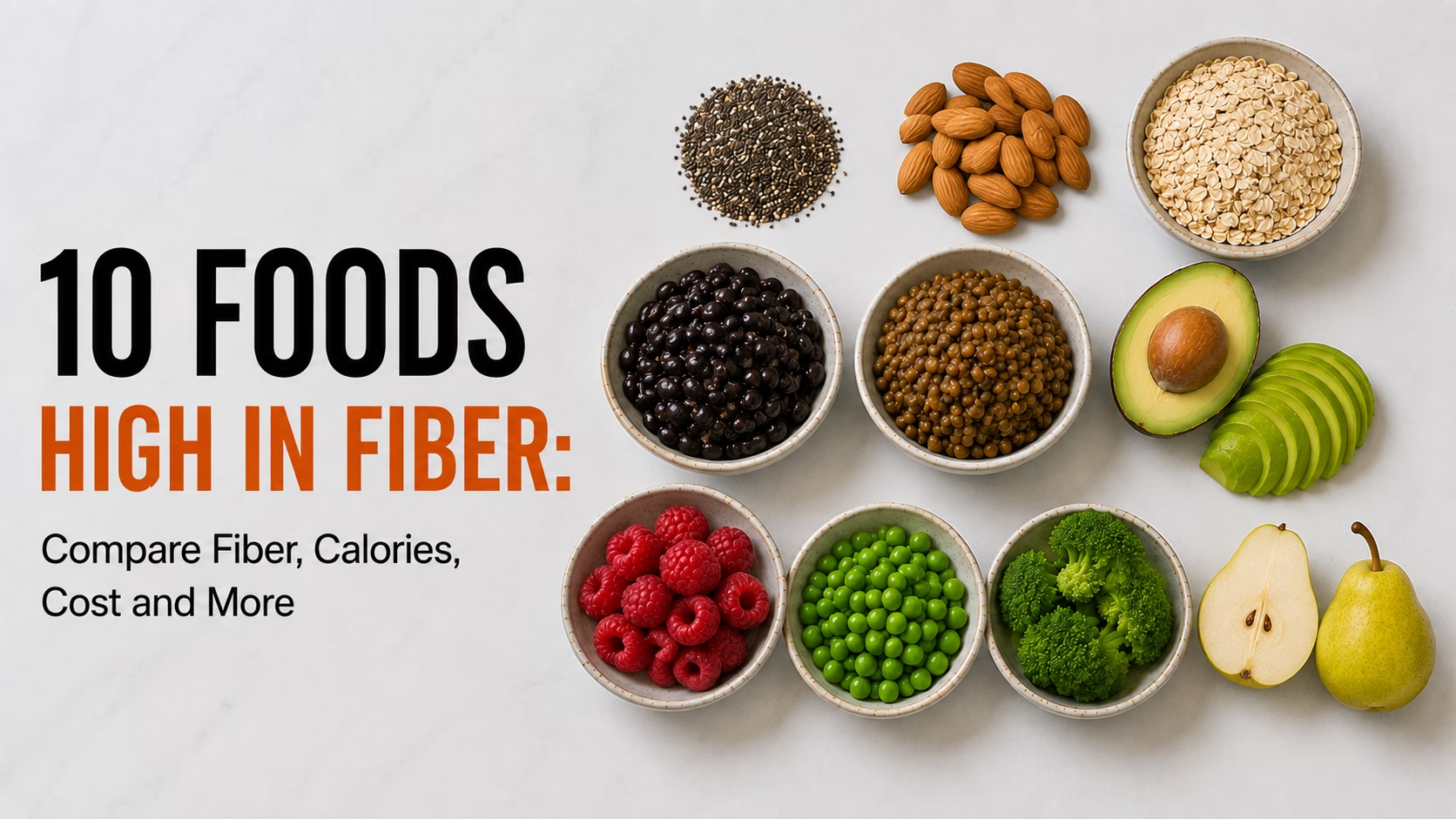
Fiber is an important part of a balanced diet, but choosing high-fiber foods is not simply about finding the food with the highest number of grams of fiber.
A food may contain a lot of fiber per 100 grams but normally be eaten in a very small portion. Another may contain less fiber by weight but provide a substantial amount in a realistic serving.
Calories matter too.
So does cost.
And different fiber-rich foods provide very different combinations of nutrients.
That is why this guide compares 10 practical high-fiber foods using several measures—not just fiber per 100 grams.
We look at:
- Fiber per 100 g
- Fiber per typical serving
- How much food provides 10 g of fiber
- Calories needed to get 10 g of fiber
- Fiber per 100 calories
- Fiber characteristics
- Other useful nutrients
- Estimated cost of getting 10 g of fiber
The goal is not to identify one universally “best” high-fiber food.
It is to help you understand the trade-offs so you can choose fiber-rich foods that fit your diet, calorie needs, budget, and preferences.
Important: Nutrition values vary by food variety, brand, preparation method, serving size, and whether a food is measured raw, dry, or cooked. The figures in this article are approximate reference values rather than exact values for every product.
10 High-Fiber Foods at a Glance
Here is the quickest way to compare the 10 foods in this guide.
The ranking below is based mainly on fiber concentration per 100 g—not overall healthfulness or the amount you would normally eat.
| Food | Approx. Fiber / 100 g | Approx. Calories / 100 g | Food Needed for 10 g Fiber |
|---|---|---|---|
| Chia seeds | ~34.4 g | ~486 kcal | ~29 g |
| Almonds | ~12.5 g | ~579 kcal | ~80 g |
| Oats, dry | ~10.6 g | ~389 kcal | ~94 g |
| Black beans, cooked | ~8.7 g | ~132 kcal | ~115 g |
| Lentils, cooked | ~7.9 g | ~116 kcal | ~127 g |
| Avocado | ~6.7 g | ~160 kcal | ~149 g |
| Raspberries | ~6.5 g | ~52 kcal | ~154 g |
| Green peas, cooked | ~5.5 g | ~84 kcal | ~182 g |
| Broccoli, cooked | ~3.3 g | ~35 kcal | ~303 g |
| Pear | ~3.1 g | ~57 kcal | ~323 g |
This table already shows why fiber per 100 g tells only part of the story.
Chia seeds contain by far the most fiber by weight among these foods, but a normal serving of chia seeds is much smaller than a serving of lentils, beans, fruit, or vegetables.
Almonds are also fiber-dense by weight, but they contain substantially more calories than raspberries or broccoli.
Raspberries contain much less fiber per 100 g than chia seeds, yet provide a large amount of fiber relative to their calorie content.
Lentils and black beans may not rank first by fiber concentration, but a realistic meal-sized serving can provide a very large amount of fiber.
There is no single winner on every measure.
How We Compared These Foods
To make the comparison more useful, we use the same basic measures for each food.
Fiber per 100 g
This shows how concentrated the fiber is by weight.
It is useful, but foods with very different water contents and normal serving sizes can look very different when compared this way.
Fiber per Typical Serving
This asks a more practical question:
How much fiber would you actually get from an amount of food you might realistically eat?
This is especially important for fiber because 100 g of chia seeds and 100 g of broccoli are not equivalent everyday portions.
Food Needed for 10 g of Fiber
Instead of looking only at percentages, this calculation shows how much of each food would provide approximately the same amount of fiber.
Ten grams is used as a convenient comparison point.
It is not intended to suggest that everyone should eat exactly 10 g of fiber at every meal.
Calories for 10 g of Fiber
This helps show the difference between fiber concentration and fiber-to-calorie efficiency.
Two foods can provide the same amount of fiber while supplying very different amounts of energy.
Fiber per 100 Calories
This shows how much fiber a food provides relative to its energy content.
Fiber Characteristics
Dietary fiber is not one single substance.
Different foods contain different combinations of fibers with different physical characteristics.
Some foods are also notable for particular fibers, such as beta-glucan in oats.
Cost for 10 g of Fiber
Food prices can be difficult to compare because foods contain very different amounts of fiber.
Instead of looking only at price per kilogram, we estimate how much it costs to obtain approximately 10 g of fiber from each food.
Other Nutrients
Fiber is only one part of a food.
We also consider nutrients such as plant protein, unsaturated fats, folate, magnesium, potassium, vitamin C, vitamin E, and other nutrients that may influence why someone chooses one food over another.
Methodology note: Nutrition figures were compiled from established food-composition references including USDA FoodData Central. Values were standardized where possible to make the foods easier to compare. Calculations for 10 g of fiber, fiber per 100 calories, percentage of Daily Value, and estimated cost per 10 g of fiber were derived from the reference values shown in this article. Because nutrient composition, serving sizes, preparation methods, and retail prices vary by product, location, and time, the results should be treated as practical comparison estimates rather than exact universal values.
10 Foods High in Fiber
1. Chia Seeds
Chia seeds are the most fiber-concentrated food in this comparison.
They provide approximately 34 g of fiber per 100 g.
However, 100 g would be a large amount of chia seeds.
A much smaller amount—roughly 29 g—can provide approximately 10 g of fiber.
What Else Do Chia Seeds Provide?
Chia seeds can also provide:
- Plant protein
- Alpha-linolenic acid (ALA), an omega-3 fatty acid
- Magnesium
- Phosphorus
- Other minerals
Why Choose Chia Seeds?
Chia seeds are useful when you want to add a substantial amount of fiber without adding a large volume of food.
They can be added to:
- Oatmeal
- Yogurt
- Smoothies
- Overnight oats
- Chia pudding
Chia seeds also absorb substantial amounts of liquid, which gives them a different texture and fiber profile from many other foods in this comparison.
2. Almonds
Almonds provide approximately 12.5 g of fiber per 100 g.
That makes them one of the most fiber-concentrated foods in this guide.
However, a typical 1-ounce serving of approximately 28 g provides closer to 3.5 g of fiber.
What Else Do Almonds Provide?
Almonds can provide:
- Vitamin E
- Magnesium
- Plant protein
- Unsaturated fats
- Other minerals
What Should You Consider?
Almonds are relatively calorie-dense.
Getting approximately 10 g of fiber entirely from almonds would require around 80 g, providing roughly 460 calories.
That does not make almonds a poor choice.
It simply means almonds provide a different nutritional package:
Fiber + protein + unsaturated fats + micronutrients
rather than fiber with very few calories.
3. Oats
Dry oats provide approximately 10–11 g of fiber per 100 g, although the exact amount depends on the product.
A common dry portion of around 40 g may provide roughly 4 g of fiber.
Why Are Oats Different?
Oats are particularly notable for containing beta-glucan, a type of soluble fiber.
They can also provide:
- Plant protein
- Magnesium
- Phosphorus
- Manganese
- Other micronutrients
Dry Oats vs. Cooked Oatmeal
This distinction matters.
Dry oats contain relatively little water.
Once oats are cooked with water, their weight increases substantially.
The fiber does not disappear, but the amount of fiber per 100 g of cooked oatmeal becomes lower because water has been added.
This demonstrates why the preparation state of a food matters when comparing nutrition values.
4. Black Beans
Cooked black beans provide approximately 8–9 g of fiber per 100 g.
A cup of cooked black beans can provide around 15 g of fiber.
That is a substantial amount in a realistic meal-sized portion.
What Else Do Black Beans Provide?
Black beans can provide:
- Plant protein
- Folate
- Iron
- Magnesium
- Potassium
- Other minerals
Why Choose Black Beans?
Black beans combine two important nutrients:
Fiber + plant protein
They work well in:
- Rice bowls
- Soups
- Salads
- Burritos
- Stews
- Bean-based side dishes
They can also be relatively economical compared with many fresh fiber-rich foods.
5. Lentils
Cooked lentils provide approximately 7.9 g of fiber per 100 g.
A cup of cooked lentils provides approximately 15.5 g of fiber.
Although chia seeds contain far more fiber per 100 g, a normal serving of lentils can actually provide more total fiber because people usually eat a much larger amount.
What Else Do Lentils Provide?
Lentils can provide:
- Plant protein
- Folate
- Iron
- Potassium
- Magnesium
- Other micronutrients
Why Are Lentils Practical?
Lentils can function as a substantial part of a meal rather than only as a topping or ingredient.
They can be used in:
- Soups
- Stews
- Curries
- Salads
- Rice dishes
- Grain bowls
They are also often one of the more affordable ways to add both fiber and plant protein to a meal.
6. Avocado
Avocado provides approximately 6.7 g of fiber per 100 g.
Around 149 g would provide approximately 10 g of fiber.
What Else Does Avocado Provide?
Avocado can provide:
- Monounsaturated fat
- Potassium
- Folate
- Vitamin E
- Vitamin K
- Other micronutrients
What Should You Consider?
Avocado is more calorie-dense than fruits such as raspberries or pears because it contains substantially more fat.
Much of that fat is unsaturated.
This is a good example of why the food with the fewest calories is not automatically the most nutritious choice.
7. Raspberries
Raspberries are one of the most fiber-rich commonly eaten fruits.
They provide approximately 6.5 g of fiber per 100 g.
One cup provides approximately 8 g of fiber.
Why Do Raspberries Stand Out?
Raspberries combine:
High fiber + low calorie density
Around 154 g can provide approximately 10 g of fiber for only about 80 calories.
They can also provide:
- Vitamin C
- Manganese
- Naturally occurring plant compounds
What Should You Consider?
Fresh raspberries can be relatively expensive, especially in countries where they are imported.
They therefore perform very well for fiber relative to calories but may perform less well when fiber is compared by cost.
8. Green Peas
Cooked green peas provide approximately 5.5 g of fiber per 100 g.
A cup of cooked peas can provide approximately 9 g of fiber.
What Else Do Green Peas Provide?
Green peas can provide:
- Plant protein
- Vitamin C
- Vitamin K
- Folate
- Other micronutrients
Why Choose Green Peas?
Green peas provide more protein and carbohydrate than many non-starchy vegetables while still contributing a meaningful amount of fiber.
Frozen peas are also practical because they store well and can easily be added to meals.
9. Broccoli
Cooked broccoli provides approximately 3.3 g of fiber per 100 g.
That looks relatively low compared with chia seeds, almonds, oats, beans, and lentils.
But broccoli contains very few calories.
Around 300 g of cooked broccoli can provide approximately 10 g of fiber for only about 105 calories.
What Else Does Broccoli Provide?
Broccoli can provide:
- Vitamin C
- Vitamin K
- Folate
- Potassium
- Other plant nutrients
Why Does Broccoli Perform Better Than It Looks?
Because fiber per 100 g is only one measurement.
Broccoli contains less fiber by weight than many foods in this guide, but it provides a large amount of fiber relative to its calorie content.
10. Pear
Raw pear provides approximately 3.1 g of fiber per 100 g.
A medium pear provides around 5.5 g of fiber.
That makes pear a useful whole-fruit source of fiber even though it ranks lower when measured strictly per 100 g.
What Else Does Pear Provide?
Pear can provide:
- Water
- Vitamin C
- Potassium
- Naturally occurring carbohydrates
The skin contributes to its total fiber content.
Why Choose Pear?
Pear demonstrates why serving size matters.
People normally eat a whole pear rather than exactly 100 g.
A medium pear can therefore provide a meaningful amount of fiber in one simple serving.
Which Foods Provide the Most Fiber per Serving?
Fiber per 100 g tells you how concentrated the fiber is.
Fiber per serving tells you how much you might realistically consume.
Using the FDA Daily Value of 28 g of fiber, we can also estimate how much of that reference amount each serving provides.
| Food | Example Portion | Approx. Fiber | Approx. % of 28 g DV |
|---|---|---|---|
| Lentils, cooked | 1 cup (198 g) | ~15.5 g | ~55% |
| Black beans, cooked | 1 cup (172 g) | ~15 g | ~54% |
| Chia seeds | 1 oz (28 g) | ~10 g | ~36% |
| Green peas, cooked | 1 cup (160 g) | ~9 g | ~32% |
| Raspberries | 1 cup (123 g) | ~8 g | ~29% |
| Avocado | 100 g | ~6.7 g | ~24% |
| Pear | 1 medium (178 g) | ~5.5 g | ~20% |
| Broccoli, cooked | 1 cup (156 g) | ~5 g | ~18% |
| Oats, dry | 40 g | ~4.2 g | ~15% |
| Almonds | 1 oz (28 g) | ~3.5 g | ~13% |
This changes the picture considerably.
Chia seeds contain the most fiber per 100 g.
But a cup of lentils or black beans can provide even more total fiber because those foods are normally eaten in larger portions.
Neither measurement is automatically better.
They answer different questions.
What Does 10 g of Fiber Actually Look Like?
For everyday comparison, one of the most useful questions is:
How much food would you need to obtain the same 10 g of fiber?
| Food | Approx. Food Needed | Approx. Calories for 10 g Fiber |
|---|---|---|
| Chia seeds | ~29 g | ~141 kcal |
| Black beans, cooked | ~115 g | ~152 kcal |
| Lentils, cooked | ~127 g | ~147 kcal |
| Avocado | ~149 g | ~239 kcal |
| Raspberries | ~154 g | ~80 kcal |
| Green peas, cooked | ~182 g | ~153 kcal |
| Almonds | ~80 g | ~463 kcal |
| Oats, dry | ~94 g | ~367 kcal |
| Broccoli, cooked | ~303 g | ~106 kcal |
| Pear | ~323 g | ~184 kcal |
Several important differences appear.
Chia seeds provide 10 g of fiber in the smallest amount of food.
Raspberries require considerably more food by weight, but the same 10 g of fiber comes with only around 80 calories.
Broccoli requires a large volume but remains relatively low in calories.
Almonds are fiber-rich by weight, but obtaining 10 g of fiber entirely from almonds requires substantially more calories.
This illustrates an important point:
Fiber concentration and calorie efficiency are not the same thing.
Which Foods Give You the Most Fiber per 100 Calories?
Another useful measurement is:
How many grams of fiber do you get for every 100 calories?
| Food | Approx. Fiber / 100 Calories |
|---|---|
| Raspberries | ~12.5 g |
| Broccoli | ~9.4 g |
| Chia seeds | ~7.1 g |
| Lentils | ~6.8 g |
| Black beans | ~6.6 g |
| Green peas | ~6.5 g |
| Pear | ~5.4 g |
| Avocado | ~4.2 g |
| Oats, dry | ~2.7 g |
| Almonds | ~2.2 g |
This ranking looks completely different from fiber per 100 g.
Raspberries move to the top because they combine relatively high fiber content with very low calorie density.
Broccoli performs strongly for the same reason.
Almonds rank lower on this particular measure because they are much more energy-dense.
That does not make almonds nutritionally inferior.
Fiber per 100 calories measures only one characteristic of the food.
Fiber Type and Characteristics
Fiber is more complicated than simply counting grams.
Dietary fiber includes a variety of nondigestible carbohydrates and related components naturally found in plant foods.
Different fibers can have different physical properties, including differences in:
- Water holding
- Viscosity
- Fermentability
- Food structure
Many natural foods contain mixtures of several fibers.
| Food | Notable Fiber Characteristics |
|---|---|
| Chia seeds | Mixed fibers; absorbs substantial amounts of water |
| Almonds | Structural fibers naturally present in nuts |
| Oats | Notable source of beta-glucan |
| Black beans | Mixture of dietary fibers |
| Lentils | Mixed fibers and resistant carbohydrate components |
| Avocado | Mixture of plant fibers |
| Raspberries | Fiber from seeds and fruit structure |
| Green peas | Mixed dietary fibers |
| Broccoli | Mixed vegetable fibers |
| Pear | Includes pectin and structural fibers |
Soluble and Insoluble Fiber
Fiber is often described as either soluble or insoluble.
This can be useful as a simple introduction, but real dietary fiber is more complicated.
Many foods contain both.
Different fibers can also behave differently depending on characteristics such as viscosity and fermentability.
What Makes Oats Different?
Oats are particularly notable for beta-glucan, a soluble fiber naturally present in the grain.
This gives oats a different fiber profile from foods such as almonds, raspberries, or broccoli.
The practical lesson is not that everyone needs to find one “best” fiber type.
Eating a variety of fiber-containing plant foods provides a broader mixture of fibers and nutrients.
Why We Do Not Give Fiber a Single “Quality Score”
Protein can be compared using established concepts such as essential amino-acid composition and digestibility.
Fiber is different.
There is no simple universal score that tells you:
“This food contains higher-quality fiber than that food.”
Different fibers can have different characteristics, and their effects can depend on factors such as:
- Fiber type
- Amount
- Food structure
- Fermentability
- Individual differences
That is why this guide compares fiber amount and characteristics rather than assigning foods a simplified fiber-quality ranking.
A food also should not be judged by fiber alone.
The overall nutritional package still matters.
Which Foods Provide the Most Other Nutrients?
Choosing fiber-rich foods should not be based on fiber alone.
| Food | Notable Nutrients Besides Fiber |
|---|---|
| Chia seeds | ALA omega-3, magnesium, phosphorus, protein |
| Almonds | Vitamin E, magnesium, protein, unsaturated fats |
| Oats | Protein, magnesium, manganese, phosphorus |
| Black beans | Protein, folate, iron, magnesium |
| Lentils | Protein, folate, iron, potassium |
| Avocado | Monounsaturated fat, potassium, folate, vitamin E |
| Raspberries | Vitamin C, manganese |
| Green peas | Protein, vitamin C, vitamin K, folate |
| Broccoli | Vitamin C, vitamin K, folate |
| Pear | Vitamin C, potassium, water |
This is why there is no single overall winner.
Someone choosing lentils may value fiber plus plant protein.
Someone choosing avocado may value fiber together with unsaturated fats.
Someone choosing raspberries may want a fruit that provides substantial fiber with relatively few calories.
Someone choosing oats may want an easy whole-grain food with beta-glucan.
How Much Fiber Do You Need?
Fiber needs vary according to factors such as age, total energy intake, diet, and individual circumstances.
A commonly used Dietary Reference Intake framework is approximately:
14 g of fiber per 1,000 calories
This is also why fiber reference amounts can differ according to energy needs.
For Nutrition Facts labeling, the U.S. Food and Drug Administration uses a Daily Value of 28 g of dietary fiber per day based on a 2,000-calorie diet.
For example:
| Fiber Amount | Approx. % of 28 g Daily Value |
|---|---|
| 3 g | ~11% |
| 5 g | ~18% |
| 7 g | ~25% |
| 10 g | ~36% |
| 15 g | ~54% |
On Nutrition Facts labels, the FDA generally uses:
- 5% Daily Value or less as a low amount
- 20% Daily Value or more as a high amount
The 28 g Daily Value is useful for understanding food labels.
It is not an individualized prescription for every person.
How Much Does 10 g of Fiber Cost?
Fiber quantity is one thing.
Fiber affordability is another.
The cheapest food by package price is not necessarily the cheapest way to obtain fiber.
A useful comparison is:
Cost for 10 g of fiber
The following prices are approximate 2026 retail reference estimates for comparison.
| Food | Approx. Malaysia Cost for 10 g Fiber | Approx. U.S. Cost for 10 g Fiber |
|---|---|---|
| Lentils | ~RM1.05 | ~US$0.36 |
| Oats | ~RM1.20 | ~US$0.33 |
| Black beans | ~RM1.55 | ~US$0.21 |
| Chia seeds | ~RM2.90 | ~US$0.38 |
| Almonds | ~RM4.00 | ~US$1.38 |
| Broccoli | ~RM4.00 | ~US$1.40 |
| Pear | ~RM4.05 | ~US$1.98 |
| Green peas | ~RM5.45 | ~US$0.53 |
| Avocado | ~RM9.00 | ~US$0.80 |
| Raspberries | ~RM18.50 | ~US$2.75 |
This comparison reveals another important difference.
Raspberries rank extremely well for fiber relative to calories but can be an expensive way to obtain fiber.
Lentils, black beans, and oats can provide fiber much more economically.
Chia seeds may cost more per package than basic pantry staples, but because they contain so much fiber, the cost of obtaining 10 g can still be relatively reasonable.
Why Cost per 10 g Fiber Is Useful
Imagine two foods:
- Food A costs RM2.00 per 100 g but contains only 2 g of fiber.
- Food B costs RM3.00 per 100 g but contains 10 g of fiber.
Food A is cheaper by weight.
But Food B provides substantially more fiber for the money.
That is why comparing the price of obtaining the same amount of fiber can be more useful than simply comparing supermarket price.
Price Note: Prices are approximate 2026 retail reference estimates used for comparison. Actual prices vary by country, retailer, brand, package size, season, availability, and promotions.
Which High-Fiber Food Is Right for You?
There is no single best high-fiber food for everyone.
The better question is:
What are you trying to get from the food?
| Your Priority | Good Choices to Consider |
|---|---|
| Most fiber in a small amount | Chia seeds |
| Most fiber in a typical meal serving | Lentils, black beans |
| More fiber with fewer calories | Raspberries, broccoli |
| Fiber + plant protein | Lentils, black beans, green peas |
| Fiber + unsaturated fats | Avocado, almonds, chia seeds |
| Fiber + omega-3 ALA | Chia seeds |
| Fiber + beta-glucan | Oats |
| Easy whole-fruit option | Pear |
| Budget-friendly fiber | Lentils, black beans, oats |
| Convenient breakfast options | Oats, chia seeds, raspberries |
| Easy frozen option | Green peas |
| Vegan | All 10 foods |
If You Want the Most Fiber in a Small Amount
Chia seeds clearly stand out.
A relatively small amount can provide approximately 10 g of fiber.
If You Want More Fiber With Fewer Calories
Consider:
- Raspberries
- Broccoli
- Lentils
- Black beans
- Green peas
Raspberries and broccoli perform particularly well when fiber is compared relative to calories.
If You Want Fiber Plus Protein
Consider:
- Lentils
- Black beans
- Green peas
- Almonds
- Chia seeds
- Oats
Lentils and black beans are especially practical because a meal-sized serving can provide substantial amounts of both fiber and plant protein.
If You Want Fiber Plus Unsaturated Fats
Consider:
- Avocado
- Almonds
- Chia seeds
These foods are more energy-dense, but they also provide unsaturated fats and other nutrients.
If Budget Is Your Main Priority
Depending on local prices, practical choices can include:
- Lentils
- Black beans
- Oats
The cheapest source can change considerably between countries and stores.
How to Add More Fiber to Your Diet
You do not need to build every meal around one special high-fiber food.
Small additions and substitutions can increase total fiber intake.
For example:
- Add chia seeds to oatmeal or yogurt.
- Include beans or lentils in soups, salads, curries, or rice dishes.
- Choose whole grains such as oats more often.
- Add peas or broccoli to meals.
- Eat whole fruits such as pears.
- Add berries when practical.
- Include nuts in reasonable portions.
- Use avocado as part of meals where it fits.
Getting fiber from different food groups also provides a wider variety of nutrients and fiber characteristics.
Increase Fiber Gradually
If your usual diet is relatively low in fiber, suddenly adding a large amount can cause digestive discomfort for some people.
Increasing fiber gradually may be easier to tolerate.
Adequate fluid intake is also important when increasing dietary fiber.
The Most Important Thing to Remember
The food with the most fiber is not automatically the best high-fiber food for you.
Fiber per 100 g tells you how concentrated the fiber is.
Fiber per serving tells you how much you might realistically consume.
Fiber per 100 calories tells you how efficiently the food provides fiber relative to energy.
Calories for 10 g fiber show how much energy comes with obtaining the same amount of fiber.
Fiber characteristics help explain why different fiber-containing foods are not identical.
Cost for 10 g fiber helps compare affordability.
And the rest of the nutritional profile tells you what else comes with the fiber.
Different foods therefore make sense for different reasons.
Chia seeds provide extremely concentrated fiber.
Lentils and black beans provide large amounts of fiber together with plant protein.
Raspberries and broccoli provide fiber with relatively few calories.
Oats provide beta-glucan and work well as an everyday whole-grain food.
Avocado and almonds provide fiber together with unsaturated fats.
Pears provide a simple whole-fruit option.
The goal is not to find one perfect fiber food.
It is to choose a variety that works for your overall diet.
Key Takeaways
- Fiber per 100 g is useful, but it does not tell the whole story.
- Chia seeds are extremely fiber-concentrated, while lentils and black beans provide very large amounts of fiber in realistic meal-sized servings.
- Raspberries and broccoli provide particularly high amounts of fiber relative to calories.
- Lentils, black beans, and green peas combine fiber with plant protein.
- Oats are notable for beta-glucan, while avocado, almonds, and chia seeds provide different combinations of fiber and unsaturated fats.
- Cost per 10 g of fiber can be more useful than package price when comparing affordability.
- There is no single best high-fiber food. A variety of legumes, fruits, vegetables, whole grains, nuts, and seeds can provide fiber together with different nutrients.
Frequently Asked Questions
What Food Is Highest in Fiber?
It depends on which foods are included and whether they are measured fresh, dry, cooked, or concentrated.
Among the everyday foods compared in this guide, chia seeds contain the most fiber per 100 g.
However, lentils and black beans can provide more total fiber in a normal meal-sized serving because they are usually eaten in larger amounts.
Is 10 g of Fiber a Lot?
Ten grams represents approximately 36% of the FDA Daily Value of 28 g.
We use 10 g in this article as a standardized comparison point.
It does not mean everyone should consume exactly 10 g of fiber at every meal.
Which Fruit Is High in Fiber?
Several fruits provide meaningful amounts of fiber.
Among the foods compared here, raspberries are particularly fiber-dense.
A medium pear also provides approximately 5.5 g of fiber in a convenient whole-fruit serving.
Avocado is botanically a fruit and also provides substantial fiber.
Which Food Gives You the Most Fiber for the Fewest Calories?
Among the foods compared in this guide, raspberries and broccoli provide particularly large amounts of fiber relative to their calorie content.
However, fiber-to-calorie efficiency should not be treated as an overall nutrition ranking.
Are Beans a Good Source of Fiber?
Yes.
A cup of cooked lentils or black beans can provide approximately 15 g or more of fiber.
They also provide plant protein and several vitamins and minerals.
Are Oats High in Fiber?
Oats provide useful amounts of dietary fiber.
They are particularly notable for beta-glucan.
The amount of fiber per 100 g changes considerably depending on whether oats are measured dry or after being cooked with water.
Is Soluble Fiber Better Than Insoluble Fiber?
Not necessarily.
The two categories describe different characteristics of dietary fiber, and many foods contain mixtures of both.
Fiber characteristics such as viscosity and fermentability can also matter, which is why it is difficult to rank all fibers using one simple quality scale.
Eating a variety of fiber-rich plant foods is a practical way to obtain different types of fiber.
Can You Eat Too Much Fiber at Once?
A sudden large increase in fiber can cause digestive discomfort in some people.
If your current diet contains relatively little fiber, increasing intake gradually and drinking adequate fluids may be more comfortable.
People with specific digestive conditions or other nutritional needs should seek individualized guidance from a qualified healthcare professional or registered dietitian.
How We Calculated the Numbers
Nutrition figures in this guide were compiled from established food-composition references and standardized where practical to make the foods easier to compare.
The main calculations include:
Food needed for 10 g fiber
10 ÷ grams of fiber per gram of food
Calories for 10 g fiber
Amount of food needed × calories per gram
Fiber per 100 calories
Fiber per 100 g ÷ calories per 100 g × 100
The resulting values are rounded because food composition naturally varies between varieties, brands, preparation methods, and database entries.
Serving-size comparisons use representative portions rather than suggesting that every reader should eat exactly those amounts.
Retail-price estimates are approximate 2026 reference values.
They are intended to show relative affordability rather than predict the exact price a reader will pay at a particular store.
Evidence-Based Sources
U.S. Food and Drug Administration
Nutrition Facts Label and Dietary Fiber
Used for the dietary fiber Daily Value of 28 g and interpretation of % Daily Value.
USDA FoodData Central
Used as a primary food-composition reference for dietary fiber, calories, and nutrients in individual foods.
National Academies of Sciences, Engineering, and Medicine
Dietary Reference Intakes for Energy, Carbohydrate, Fiber, Fat, Fatty Acids, Cholesterol, Protein, and Amino Acids
Used for dietary fiber definitions and reference intake concepts, including fiber intake relative to energy.
Mayo Clinic
Chart of High-Fiber Foods
Used for practical serving-size fiber comparisons for foods including lentils, black beans, chia seeds, raspberries, peas, pears, broccoli, and almonds.
National Institutes of Health
Health Benefits of Dietary Fibers Vary
Used for background on why different dietary fibers can have different characteristics and why fiber should not be treated as one uniform substance.
Disclaimer
This article is for general informational and educational purposes only. It is not intended to provide personalized dietary, nutritional, or medical advice.
Nutritional needs vary according to factors such as age, body size, activity level, health status, and individual circumstances. People with specific medical conditions or nutritional needs should consult a qualified healthcare professional or registered dietitian for advice appropriate to their situation.